

Since the 4th Joint National Conference at Abuja, themed ‘Compassion, Competence and Character’, the word compassion has increasingly become a reference point for CMDA Nigeria members, and a rally to go the extra mile for our patients. For most of us, compassion is usually conceptualised as a warm hand on the shoulder, a listening ear, a proactive presence and sometimes, financial support. All these are indeed practical and very significant expressions of compassion, however, are severely limited as we often come to terms with sooner or later.
Some months ago, at a CMDA Nigeria Doctors’ Chapter meeting, we discussed the matter of showing compassion in our practice. During the session, a question that really reflects the mind of many christian doctors was asked: How do we really sustain compassion in a healthcare system that increasingly seems boxed in on all sides? How many patient bills can we support and for how long? How many indigent patients can we run around the wards for and for how long? How much time, energy and resources should we expend for one patient, knowing that there are other patients actively waiting or soon to arrive? These questions highlight a problem with the ‘one patient per time’ kind of compassion: it gives little consideration to the next patient, the resources available, the healthcare professional expended in the process, and contributions of other non-clinical healthcare professionals, whose work cannot be overlooked. It also fails to account for the systemic challenges that have limited care, and in most cases has played a very significant role in the problem ab initio. This ‘bedside kindness only’ approach to compassion quickly becomes frustrating in the least, and ultimately proves ineffective, and unsustainable. Should the problem of that index patient be considered in its full length, breadth and depth, with attention given to how it can be solved rather than merely patched or alleviated, the limitations of bedside kindness becomes obvious. The need to address the patient’s problem at community, institutional and systemic levels also becomes apparent.
What defines compassion is that it goes beyond understanding and feeling the suffering of others to finding out the root problem of the suffering and addressing it. Compassion is the foundation of quality healthcare provision, and for the Christian healthcare professional, it is more—an eternal imperative modelled by the life of Jesus, as it is recorded at several times that being moved by compassion Jesus went about healing the sick, and delivering the oppressed.

Compassion can be demonstrated at three levels:
(A). Self-compassion, which is the internal orientation that allows the professional to consider him or herself, and that sustains the capacity to care without being ‘destroyed’ by it.
(B). Inter-personal compassion, which is expressed directly towards others; then
(C). Structural compassion, which is expressed towards others but at institutional, systemic and societal levels. Structural compassion ultimately allows the interpersonal to flourish at scale. When the systems and structures are weak or absent, compassion becomes a lot more challenging and less impactful.
This expanded approach to compassion, which in the real sense is simply compassion, considers the ultimate end goal of compassion, the availability and limitations of resources, the various stakeholders involved in addressing the patient’s needs, the several other patients that require care, and the well-being of the healthcare professional. It reshapes institutions, informs policies, extends to patients who are yet to present, and—most provocatively—calls the clinician to look beyond the comfort of codified rules.
The broadening of our approach to compassion is also rooted in Jesus. He not only healed and delivered when moved by compassion, he also acknowledged the need for more ‘workers’: “When he saw the crowds, he had compassion on them…. He said to his disciples, “The harvest is great, but the workers are few. So pray to the Lord who is in charge of the harvest; ask him to send more workers into his fields.” Matthew 9:36-38. Beyond the index ‘patient’ needing healing Jesus, still being moved by compassion, taught and trained his disciples to heal and deliver like he did, and ultimately gave himself up. By this action, he made it possible for all, not just those who could meet him, to be healed and delivered. In his absence, he sent the Holy Ghost who will provide other resources needed to continue the duty of healing and deliverance.
What defines compassion is that it goes beyond understanding and feeling the suffering of others to finding out the root problem of the suffering and addressing it.
It is important to note the relationship between seeing and being moved with compassion. Policy makers, health administrators, and all who are not in regular contact with the index patient are encouraged to periodically make room to see the patient in need of care, to see the people who are affected by policy decisions and in doing so our spirit can be really stirred up again and again.
It must also be noted that this approach to compassion does not suggest that the Christian resident doctor may withhold his acts of compassion, until the hospital administration or public office has done their bit to support compassionate care. Rather it calls on all healthcare professionals at all levels to be a part of compassionate care, including the health policy maker who may never see a patient in the whole of a year. It calls all healthcare professionals to recognize that the work they do in the healthcare system, clinical or non-clinical, ultimately amounts to healing and delivering the sick and oppressed, and should be done with the consciousness of Christ; it challenges all healthcare professionals to aspire to solve, rather than patch, the problem of the patient.
Compassion in healthcare is such care that is rooted in God’s love, is intelligent (this is, competent, ethically-grounded, and distributive), collaborative, supportive of the care provider, vertically-integrated and sustainable.
Is your compassion sustainable or catatrophically ‘out-of pocket’?
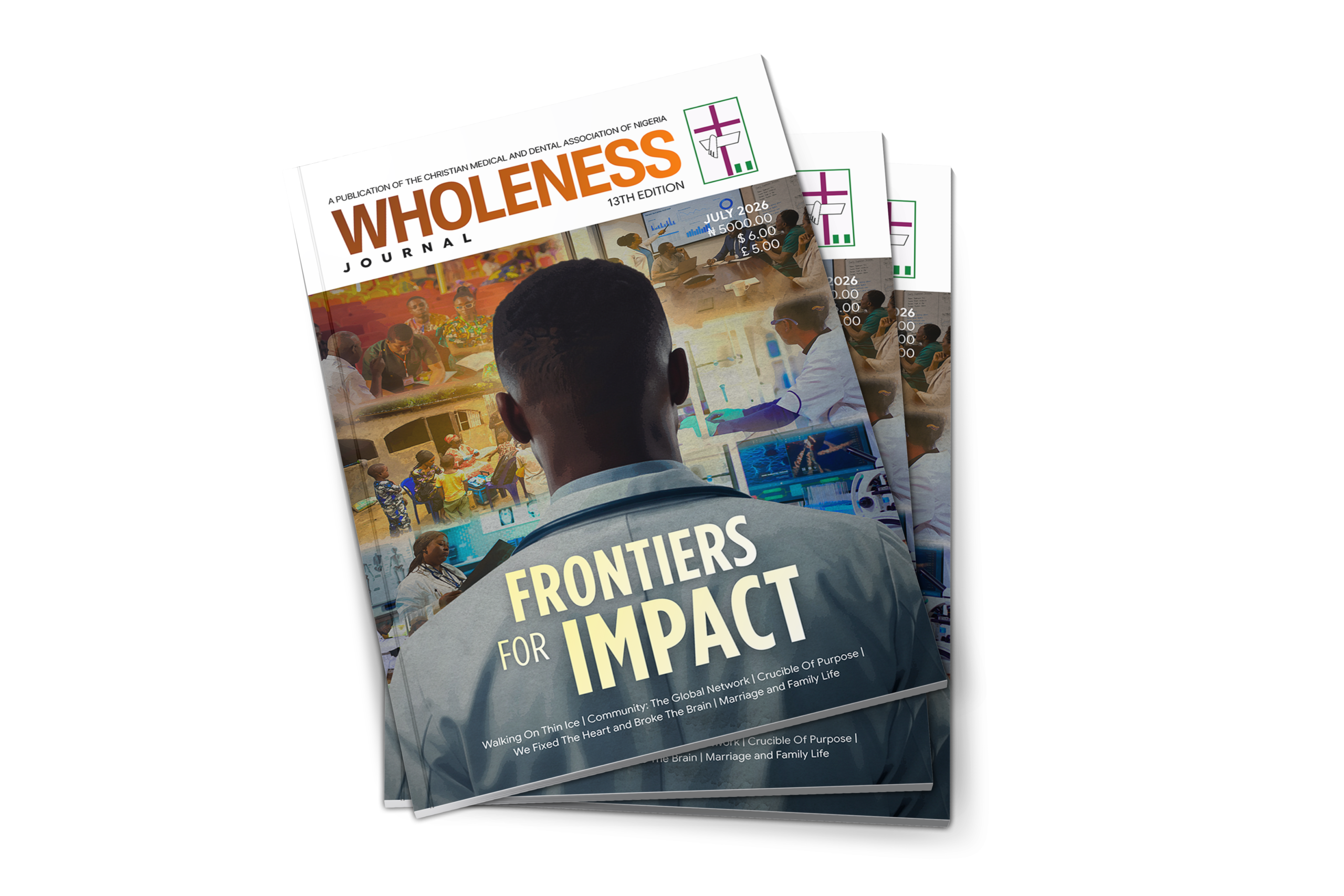
Culled from the Wholeness Journal 13th Edition. Get a copy here

Author | Dr. Fervent Idakwo
Medical Officer, Programs and Communications Director (Institute for Excellence in Healthcare and Leadership). He shares insight on leadership and personal transformation.
Check out this amazing video. You will be blessed by it
